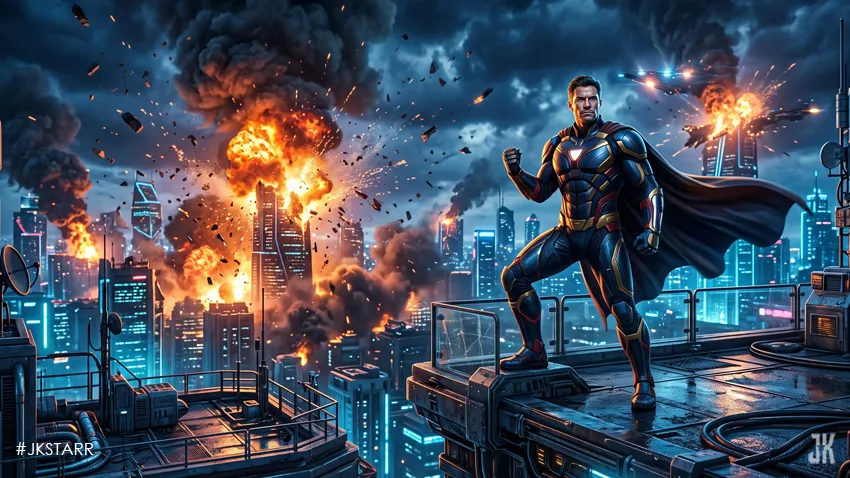
Superhero movies today are among the most visually spectacular films ever made. Whether it is entire cities collapsing, heroes soaring through the sky, or epic clashes between god-like beings, almost everything you see on screen is brought to life through advanced Visual Effects (VFX).
Without VFX, modern superhero cinema as we know it simply would not exist.
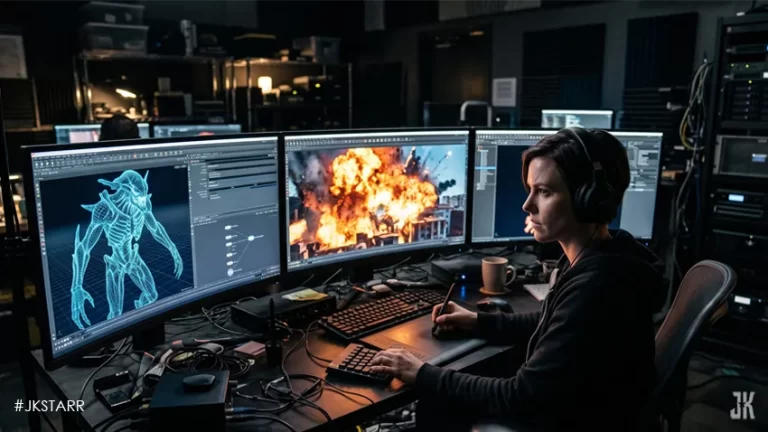
Studios like Marvel and DC rely heavily on massive VFX pipelines that involve hundreds, sometimes thousands, of artists collaborating across the globe. These teams seamlessly blend live-action footage with computer-generated imagery (CGI) to create scenes that would be impossible, or frankly, too dangerous to film in real life.
This guide explains the complete end-to-end VFX process used in superhero movies—from the earliest planning stages to the final polished frame.
- 💥 Why Superhero Films Depend on VFX
- 🧠 Pre-Production: Planning the Impossible
- 🎨 Concept Art & Previsualization
- 🎥 On-Set Production Techniques
- 🟢 Green Screen & Motion Capture
- 👾 Digital Character Creation
- ⚡ Simulating Superpowers
- 🏙️ Destruction & Environmental Effects
- 🧩 Compositing: The Final Blend
- 🔊 Sound Design & Final Polish
- ⚠️ The Major Challenges in Superhero VFX
- 🚀 The Future of VFX in Cinema
- ✅ Conclusion
💥 Why Superhero Films Depend on VFX
Superhero narratives inherently involve abilities and events that defy the known laws of physics. Characters fly without wings, shoot energy beams from their hands, shrink to the size of ants, or survive massive explosions.
VFX allows filmmakers to simulate these actions safely while maintaining a photorealistic look. Furthermore, it provides directors with total creative freedom to design alien planets, futuristic futuristic cities, and cosmic realms without physical limitations.
Digital effects are also crucial for consistency. A superhero’s suit, powers, or physical appearance must look identical across dozens of different scenes and even across multiple franchise films. Achieving that level of continuity requires total digital control over the visuals.
🧠 Pre-Production: Planning the Impossible
The visual effects process begins long before the cameras start rolling. During pre-production, filmmakers must meticulously plan every shot that will involve VFX. This stage determines the budget, shooting schedule, and technical requirements.
Directors collaborate closely with VFX Supervisors to identify which shots will be CGI, which can be done practically, and how the two will interact. They also plan camera movements, lighting setups, and how actors will interact with digital elements that aren’t there yet.
Detailed storyboards—essentially comic book panel versions of the script—are drawn to visualize action sequences. These act as a visual roadmap for the entire crew, ensuring everyone understands what the final shot needs to convey.
🎨 Concept Art & Previsualization
Before anything is built digitally, artists establish the visual language of the film.
- Concept Art: Illustrators create paintings defining how characters, specialized costumes, high-tech gadgets, alien environments, and superpowers should look. This artwork ensures visual consistency throughout production.
- Previsualization (Previs): This takes storyboards into the third dimension. Using rough 3D models, artists animate complex sequences before filming begins. These rough animated scenes establish camera angles, timing, action choreography, and scale. Previs is invaluable for planning massive battle scenes.
🎥 On-Set Production Techniques
When principal photography begins, specific techniques are used to capture footage that will integrate seamlessly with CGI later.
Actors often perform on incomplete sets or against large blue/green screens. Physical props are crucial here. If an actor is supposed to hold Thor’s hammer, Mjolnir, they hold a physical weight-reference prop on set. Later, VFX artists replace that prop with the detailed, glowing digital hammer.
Lighting reference spheres (chrome and grey balls) are placed on set in every new lighting setup. These help VFX artists understand exactly how light behaved on the day of shooting so they can match the CGI lighting perfectly.
🟢 Green Screen & Motion Capture
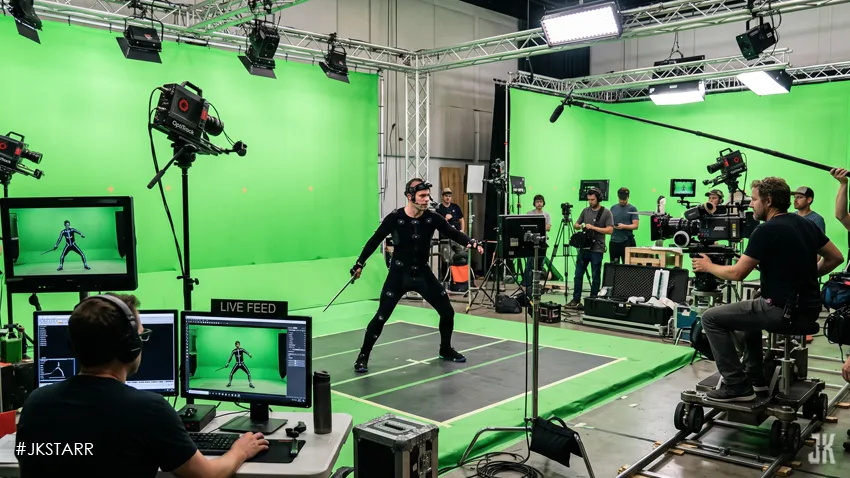
- Green Screens: These are perhaps the most recognizable VFX tool. They allow editors to “key out” the background and replace it with a digital environment (like the surface of an alien planet or a destroyed New York street). Green is used because it is a color furthest removed from human skin tones.
- Motion Capture (Mocap): This technology records the performance and movements of a real actor. The actor wears a tight suit covered in reflective markers or sensors. Cameras record these markers, translating the live performance onto a digital skeleton. This is used for characters like Thanos, Hulk, or Rocket Raccoon to ensure their movements remain emotionally nuanced and human.
👾 Digital Character Creation
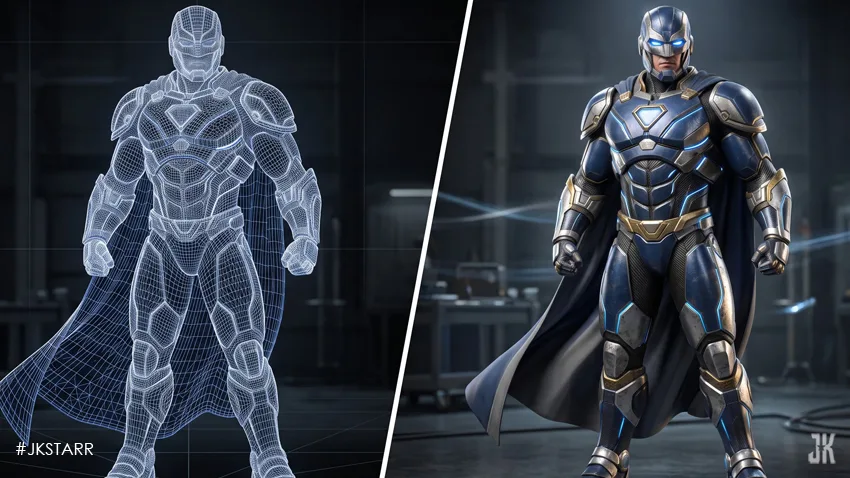
Many characters in superhero films cannot exist physically—think aliens, robots, fully CG heroes, or monstrous villains.
- Modeling: Artists sculpt detailed 3D models of the character, defining their anatomy, muscle structure, and surface details.
- Texturing: Shaders and maps are applied to give the model realistic skin pores, metallic reflections, or fabric weaves.
- Rigging: Technical directors build a complex virtual skeleton inside the 3D model, complete with joints and muscle systems, allowing animators to move it naturally.
- Animation: Animators use either mocap data or manual keyframe animation to give the character life, refining facial expressions and subtle movements.
⚡ Simulating Superpowers
Creating believable superpowers requires a blend of art and physics.
Whether it is Iron Man’s repulsor blasts, Doctor Strange’s magical mandalas, or The Flash’s superspeed, these effects must look spectacular yet grounded in reality. VFX artists use advanced particle systems and fluid simulations to generate fire, smoke, electricity, and energy trails.
Timing is critical. The digital effect must sync perfectly with the actor’s physical movement to sell the illusion that the power is emanating from them.
🏙️ Destruction & Environmental Effects
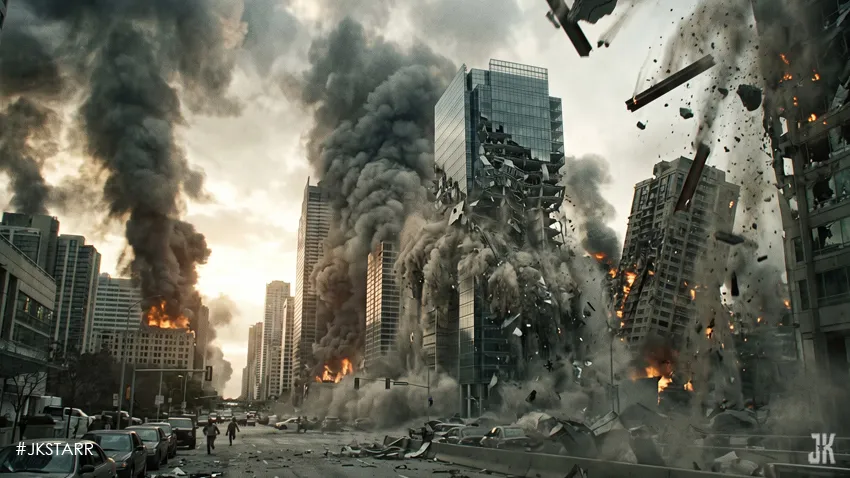
Large-scale destruction is a staple of the genre. When a building crumbles or a helicarrier crashes, it is almost always digital.
Creating this involves running complex physics simulations. Software calculates mass, gravity, and material strength. It dictates how glass shatters, how concrete cracks and crumbles, and how steel bends under stress.
On top of these rigid body simulations, artists layer environmental effects like massive dust clouds, fireballs, smoke, and debris. These elements are crucial for selling the sheer scale of the destruction.
🧩 Compositing: The Final Blend
Compositing is the final stage of the VFX pipeline. It is where every single element—live-action plates, CGI characters, digital backgrounds, particle effects, and lighting passes—are combined into one single image.
Compositors act as digital magicians, ensuring that the black levels, color balance, focus (depth of field), and lighting interactions between real and digital elements are perfectly matched. They add atmospheric haze, lens flares, and film grain to make the final shot look cohesive and cinematic.
🔊 Sound Design & Final Polish
While not strictly VFX, sound is essential in making the visual effects believable. The loudest explosion looks empty without the right boom, crackle, and debris rattle. Sound design provides the weight and impact for visual effects.
Finally, Color Grading is applied across the entire movie to ensure a consistent visual tone, balancing the colors of the VFX shots with the live-action footage.
⚠️ The Major Challenges in Superhero VFX
Creating VFX for this genre is incredibly demanding:
- Tight Deadlines: Blockbuster release dates are set years in advance, but shooting often runs late, leaving VFX studios with very little time to complete thousands of complex shots.
- Massive Scale: A single film can have 2,500+ VFX shots, farmed out to ten or more different vendors worldwide. Ensuring visual consistency across all these different studios is a massive logistical challenge.
- High Expectations: Audiences are incredibly savvy. If a digital character looks slightly “off,” it pulls the viewer out of the movie (often referred to as the “Uncanny Valley”).
🚀 The Future of VFX in Cinema
The landscape of VFX is rapidly evolving.
- Virtual Production (LED Volumes): Technologies like The Volume (used on The Mandalorian) allow filmmakers to display photorealistic digital environments on massive LED screens while filming. This means actors are lit by the actual digital environment, and much of the final image is captured in-camera.
- Real-Time Rendering: Game engine technology (like Unreal Engine) is allowing filmmakers to see near-final quality VFX on set, speeding up decision-making.
- Artificial Intelligence: AI is beginning to assist artists in tasks like rotoscoping, tracking, and upscaling resolutions, helping to streamline the pipeline.
✅ Conclusion
The stunning visual effects in superhero movies are a complex synthesis of art, engineering, and sheer human endurance. From the initial sketches in pre-production to the final compositing render, every stage requires immense talent and problem-solving.
What audiences perceive as effortless action on screen is actually the result of years of innovation and the dedication of thousands of artists. Without VFX, modern superhero storytelling would simply have no way to take flight.
Understanding this process not only deepens our appreciation for these films but also highlights the incredible evolution of filmmaking technology.


[ TRANSMISSION REPLIES // COMMENTS ]